“Although this text was written to be published before the anniversary of Labor Day in 2026 and therefore
contains some historical references to Labor Day, it remains relevant today.”
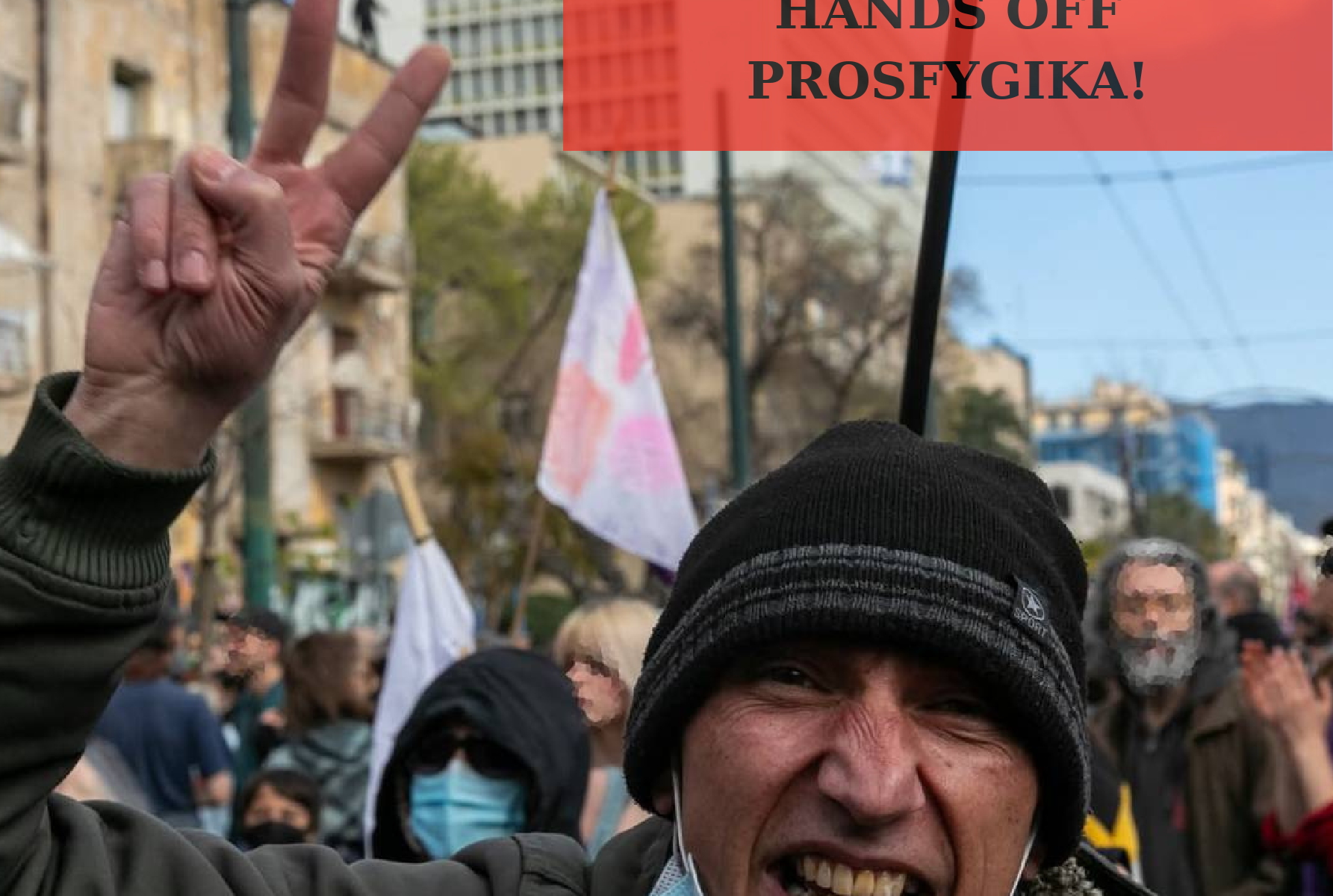
Call for Escalation of Acts of Solidarity with the Community of Squatted Prosfygika Call for participation in the International Worker’s Day, May 1st demo
CallforparticipationintheSolidaritywithProsfygikaDemoonthe16thof May
Beginning this hunger strike, I wrote a short — though I believe concise and comprehensive — letter titled “Message to society, to my family and to my friends”i, aiming to help others better understand the hunger strike I began on 5 February 2026. Before moving to the main subject, I must say that from the start of the hunger strike, until the moment these lines are being written, I have been approached by people from all three of the groups that I addressed in my message — and depending on the courage or even the audacity of some, or on the familiarity they have with me, some directly and others indirectly — aiming to persuade me to change my decision.
This was something I was aware of before even beginning the hunger strike: that both I personally and the Community itself— especially its other political members — would face this situation. I also know that as my health deteriorates, the appeals to end the hunger strike will multiply. Up to this point I do not blame those who do so, so long as they do not cross into hostility toward what I represent as a political member of the Community of Squatted Prosfygika— meaning that they do not criticize and badmouth the struggle within close or wider circles, nor attack directly or indirectly the Community or its other members. Anyone who acts in this way, be it due to their inability to control their emotions or impulses, indirectly plays into the hands of state repression — not only against the Community of Squatted Prosfygika, but in general against the world of communities, self-organization, solidarity, social resistance and even against the very method of struggle that is the hunger strike itself.
I must clarify that I am not engaging in conspiracy accusations, nor do I have any intention of accusing anyone who approached me of being “hostile,” whether toward me, the Community or the broader resistance movement. On the contrary, I understand that this was done with the best of intentions and out of love for my life and my person and all of them stand in solidarity, with some even going beyond their limits in doing so. However, I would like to focus on how repressive mechanisms exploit instincts, emotions and impulses, to such a degree that in some cases they can control not merely individuals or organizations, but entire social groups on a large scale.
Special warfare for the manipulation of societies and movements
I will not report in general the various methods extensively used by state mechanisms to break hunger strikes of political prisoners in Turkey, Northern Kurdistan, Palestine, the United States and elsewhere. Instead, I will focus mainly on the experience of Northern Ireland with what British officials called “capitulation”. According to documents released during the previous decade by the National Archives of Northern Ireland, there are references to how one of the methods used to suppress hunger strikes was the “capitulation” of the striker, by manipulating — or simply exploiting
— the anguish of their families, in cooperation with Catholic priests, in order to persuade the striker to end the hunger strike. Although the goal of “capitulation” was not met in great success except for a few cases, we cannot ignore that the families of the strikers played a significant role in the pressure exerted on the IRA to end the hunger strikes, nor that, with the consent of the families, any striker who fell into a coma would have the hunger strike terminated. Here I am not judging whether that decision was right or wrong; I am simply presenting the historical reality.
Emotional manipulation is not merely a tactic, but one of the principal weapons used to manipulate societies and suppress movements, because instincts, emotions and impulses constitute the primordial survival system that often operates independently of reason. Basic instincts for survival and self-preservation — such as hunger, thirst, and reproduction — activate the amygdala, the emotional center of the brain, faster in a way that the prefrontal cortex is effectively deactivated, especially under conditions such as fear and anxiety.
media are used on a mass scale by the population as a whole, we are obliged to intervene within them as well, alongside other forms of social engagement and propaganda.
There is already the collective experience of the slander directed at Panos Routsisii during his hunger strike — to mention a recent example outside the classic trope of the imprisoned for “illicit” acts hunger striker — as well as the smear campaigns of the various trolls on social media. Similarly, in my own case, I have seen many comments discrediting the hunger strike, arbitrarily arguing that I have already surpassed the human starvation endurance limits, citing Bobby Sands as an example, and generally attempting to diminish, belittle, or ridicule the struggle. While major mass media remain silent, and while there is no pushing to raise awareness of the issue to the degree it deserves, propaganda mechanisms are meanwhile already shaping public opinion so that by the time the striker’s health reaches a critical condition, society will already have been conditioned — with the aim of exerting psychological pressure and exhaustion both on the striker and on solidarity movements.
Politicizing emotions
Those with sincere intentions who attempt to change my mind regarding my decision on the hunger strike are clearly driven by emotions. Either this emotion is sadness at the thought that I may suffer irreversible harm or lose my life, or anger and disgust at the thought that my Community may be exploiting me and thus not urging me to stop. We know that combining emotions results in complex feelings such as anxiety, rage, anguish and despair — emotions capable of influencing a person’s behavior, pushing them either to act in order to prevent an unwanted situation that generates these feelings, or to give up altogether. As an aside, I will only briefly touch upon the fact that the worst thing in struggles is despair — that is, the loss of faith in the just conduct of the struggle, in the final victory, the loss of hope. Without hope there is no guarantee of even the slightest prospect of smooth sailing. No matter how bad things may be, as long as hope exists, there remains a driving force; the loss of hope brings stillness. Another even more complex social emotion is contempt, whether directed towards the Community and its demands, or towards me personally. The highest of complex emotions, of course — and the one I would like to dwell on for a moment — is love. Are we certain that what we interpret as love is always something positive? Are we certain that it does not contain influences from the world of authority, thereby mirroring it? After all, don’t our very personalities contain contradictory tendencies and countless inconsistencies as a result of having been shaped by the patriarchy, the state, capitalism and individualization? Can someone truly love while refusing to respect the choices of the person they love? I will not go into detail about the plethora of toxic emotions and behaviors that can even lead to criminal acts committed in the name of love.
In no way do I mention all this in order to demonize instincts, emotions and impulses that are so useful for survival, expression and emotional openness. However, it is important — first and foremost as social beings and even more so as revolutionary forces — that we learn to control the behaviors these emotions lead us toward, especially when we know that the forces of counterrevolution use them to control populations. Emotions are, to a large extent, constructed by the societies in which we were raised, by rules, values and ideologies, while some of them are suppressed or restricted by whichever authorities hold power. In any case, emotions define our identity. The better we know ourselves, understand how we want to live and what our goals are, the more capable we become of controlling our impulses according to our purposes, our political identity and the ethics we develop within our collective processes, our communities and our societies.
Authority has always — especially during and after the colonial era — employed strategies to construct images of colonized or soon-to-be-colonized peoples that served its interests, in order to distort their cultural identity, impose itself upon them and ultimately colonize them. The declarations of repentance in Greece, the CIA-funded shock therapy experiments on psychiatric patients that were later applied to political prisoners and hostages of war and continue to be applied to entire societies around the world, traditional torture methods, and, more recently, social media, the spread of narcotics, fashion, music and cinema — all of these are, or can become, tools and strategies through which individuals and societies lose their identity.
The building of social bonds, solidarity structures, self-organization and collectivization — allowing individuals to take an active role in common affairs and enabling societies to institute themselves according to their commonly recognized material and spiritual needs — is the true self-defense of societies against alienation by the state and capitalism. In this way, we achieve self-awareness and become capable of charting our direction as societies without our identity being alienated by the culture of domination.
The Community of Squatted Prosfygika, in this continuous process of constructing its collective identity, when faced with the dilemma of collective identity and self-defense versus individualization, was able to respond calmly because it had attained at least the minimum necessary degree of self-institution. Within this network of sincere social relations, moral principles, tolerance, and inclusiveness, all the necessary processes take place through which the individual personality is strengthened within the collective social identity. Communal culture is the catalyst that pushes every “I” to decide to defend the “we.” Under these conditions, we decided to join hands in defence of our collective identity — even if it means dancing the Dance of Zalongoiii.
What distinguishes initiative from reflex, is action versus reaction
Individual initiative is not a sudden impulse or a reflex of panic due to a pressing situation. Ultimately, it is not even individual, but rather the product of a set of situations and discourses that influence the individual carrying these acts out under specific conditions. For example, what sensible person would take the risk of an initiative, if they were not certain that all the appropriate conditions exist to support and ensure the success of the initiative? The motivation, the moral framework of the initiative and the outcome are ultimately what determine whether the initiative was sound. On International Worker’s Day, I will be on my 86th day of hunger strike, and as of the moment these lines are being written, the Region of Attica, the Municipality of Athens, the state and the government, as well as the major media outlets controlled by them, have shown characteristic indifference regarding the Community’s demands, our fair struggle and the state of my health. In the face of the escalation of repression or the silencing of the issue, we had declared from the very first days that the initiative of the hunger strike to the death would be supported by other members of the community. On May 1st, two hunger strikers will join our hands and lead the way, shouting the words of August Spies: “THE DAY WILL COME WHEN OUR SILENCE WILL BE MORE POWERFUL THAN THE VOICES YOU STRANGLE TODAY”.
A long-overdue response to those who wish to change my mind
How could you possibly change my mind, whether you are my community, my friends and comrades, or my family, or solidarians, since this was not just the decision of a person who is committed to social movements as an anarchist, fully conscious of the purpose, the means and the issues at stake, weighing the costs and benefits and having deep faith in our collective identity as a current reality under the conditions that have shaped it, as an evolutionary dynamic and as a proposal for the future in the face of a world of individualization? How is it possible that an initiative that, in its totality, but also as the imprint it seeks to leave, embodies the collective identity of the communal way of life, can break away from the individualized solution of escape?
I cannot state it more clearly, than to say that the conditions under which the decision was made regarding this specific hunger strike are the impending deaths, concentration camps, pushbacks, court cases and the uprooting of vulnerable social groups, children and families, as a result of the plan for the “redevelopment,” repression and evacuation of refugee camps. An impending Calvary for a group of people from diverse social and political backgrounds who, due to the situation each will face individually, will not even have the opportunity to support one another as they would under normal circumstances. The vast majority of them, being unknown within the solidarity movement, will not be sought out by anyone.
We consider what the cost of ending a hunger strike that has not yet reached its peak and what the cost is of ending any struggle that has not yet reached its peak will be. Ultimately, what is the climax of a struggle if not victory, or at least the exhaustion of all efforts toward the goal of victory, or at least some partial achievements satisfactory to that goal? What consequences will this have for future hunger strikes? With what skepticism will society view them, if it is imprinted in the collective subconscious that the means of struggle used as a last resort are devalued by the very person who chose them as a means of struggle? What arguments and methods will such a precedent arm the repressive arsenal with? What legacy will we leave for future struggles and future generations when we stop our struggles, when we do not make demands, when our struggles do not reach their peak, when we react reflexively to the state’s moves, when we do not know how to recognize the right moment to take the initiative?
How can we imagine that the 200 of Kaisarianiiv marched with such determination and raised fists, with dignity in the face of the enemy’s rifles, if they had not possessed that collective spirit, their organizational procedures within Haidari prison camp, the conviction that their united stance would be etched forever in the enemy’s mind, in the lens they saw focused on them, viewing them as a trophy in a collection? These photographs came to light at the most opportune moment to show all of us that those who resist can walk tall and proud toward death with the certainty of the victory to come, even though they know they will never live to see it.
Ending the hunger strike on my part would suggest that there are no serious reasons for it and would undermine the demands of the strike, while we have already described that what lies ahead is the destruction of a social whole, a social project. It would undermine the Community of Squatted Prosfygika and render the very means of the hunger strike meaningless, leaving a poor legacy for any future hunger strike and for future struggles and future generations as a whole.
“Ideas do not get evicted”
Unfortunately, the defeats of the past have led us to fight without expecting a victorious outcome, to give up before we even begin, to make no demands, to fight at the lowest possible cost even when we lose hard-won gains that were paid with rivers of blood.
For years, the chant and quote “ideas are not evicted” has been following every eviction of squats and self-organized projects and indeed this is true, this is how it must be and this is what we must continue to uphold, if we wish to continue to exist. Defending the “idea” means not betraying it, not bowing your head, continuing the struggle. For example, in every courtroom where an activist
defends their “ideas” without regard for the cost, they simultaneously build a material foundation. They shield their “ideas” from the mechanisms of repression, energize the solidarity movement, spread their “ideas” and inspire new militants. Such a legacy was left by our anarchist comrades Marianna Manoura and Dimitra Zarafeta during the Ampelokipi trialv, where they defended their political identity, defended the political identity of the anarchist martyr Kyriakos Ximitiris, defended anarchy, defended the “idea.”
But can the “idea” continue to exist without the material entity that carries it, without the material ground on which it is rooted? Do we understand the dialectical relationship between ground and “idea”? For how long can the “idea” continue to exist if it is not grounded in soil? When we say that “ideas are not empty” or when we defend our “ideas,” we clearly mean our collective identity, our beliefs, our moral principles, our values and so on. Ultimately, would any of this have any meaning if there were no material ground for them to manifest? Historically, many of the tribes uprooted by colonialism also lost their “ideas,” their beliefs and their collective identity. Similarly, the modern urban way of life, by displacing the traditional rural way of life, has also displaced communal culture as a collective identity. These “ideas” are called upon to fulfill a collective need; a collective identity develops, becoming culture, an institution, a civilization. Internal migrants who lost touch with their homeland saw their needs shaped by the new conditions of urban life and their identity adapting to these new conditions. In other words, whereas in rural life collective labor is a material necessity, mutual aid is dictated by harsh conditions and social interaction is shaped by the physical layout of the landscape, urban life is structured in a way that promotes individualism, isolation and alienation.
Militants who defended their “ideas,” their identity, their beliefs and their values in courtrooms continued their struggle both within and outside the city walls.
In the case of Prosfygika, the “idea” of a community did not bloom easily, even though a sense of community existed in the imagination of some of the squatters. What ultimately contributed to the creation of the Community was the space itself and the material and spiritual needs under the given circumstances. Based on these needs, the individual structures were created, along with the organizational structure and operation, the decision-making process, the statutory framework of principles and operation and so on. All of these evolve and feed back into a dialectical relationship between territory, material and spiritual needs, collective identity—culture, self-determination, critical renewal and change.
Could the “idea” of the Community continue to exist in a situation where its foundation is lost, where it fails to collectively defend its most vulnerable members and where there are natural drifts and displacements, disconnection and dispersal of its members? How could the “idea” continue to exist once the material realization of the “idea” has been completely liquidated?
An extreme positivist might say that what matters is that the experiment succeeded, and therefore the theory is applicable; but aside from the fact that we do not view ourselves as lab animals, human relationships develop within communities, not subject-object relationships.
The more ground we cede to authority, the more we surrender our hard-won gains; if we do not resist, we ultimately lose or adapt our “ideas” to the new conditions. There are many historical examples where physical defeat was followed by ideological defeat; the consequences of past mistakes haunt the struggles of today.
The hunger strike as a last resort to highlight just and well-founded demands, a just struggle
A hunger strike is a form of protest in which the striker decides to put their health and very life at risk to highlight an issue that is a matter of life and death. To avoid being seen as abusing this mean of struggle or unreasonably blackmailing those they are addressing—whether it be public opinion or a solidarity movement they wish to rally around them—it is not enough simply to have just demands in a general and vague sense; but there must also be a flagrant injustice being committed by the institutions.
The potential eviction of refugees violates a number of human rights and a multitude of provisions and articles of Greek, European and international law, as well as European and international conventions, such as:
a) violation of the right to adequate housing, b) violation of the inviolability of the home, c) violation of the right to a fair trial, d) violation of the principle of equality and non-discrimination, e) violation of the right to human dignity and personal development, f) violation of the protection of the family and children.
Furthermore, the interventions proposed by the Region of Athen’s study alter the character of the buildings themselves, which have been designated by the Ministry of Culture and the Council of State as preserved monuments of modern history and cultural heritage.
Under such circumstances, a hunger strike serves as a means of pressure aimed at preventing injustice, directly presenting the institutions with the dilemma of either rectifying the injustice or bearing the responsibility for the cost of the immediate loss of human life. Of course, when we speak of institutions, we are not referring to something abstract and detached from the central system of the culture of power, but to very specific organizations created in the image and likeness of the patriarch of institutions—the state— whose very foundation is injustice. The only certainty is that the state will do everything in its power to make no concessions and to drive the striker to the point of resignation. There are numerous examples in recent years where the Greek state has pushed hunger strikers to the absolute limit, risking irreparable damage to their health or even their death. The state takes risks and plays with the striker’s life despite the reactions of the solidarity movement, which in some cases was quite widespread. The state is clear: it does not back down, it does not yield to blackmail, it does not bypass the necessary institutional procedures, it does not abolish institutions, it places the blame on the striker themselves, it calls on the striker to end the strike, and the rest is in the hands of doctors and hospital staff.
The question of cost arises as to whether it is in the state’s interest and whether it is capable of managing the tension and instability that an impending death from a hunger strike might bring, especially when the demands of the strike are grounded in international human rights conventions. A decisive role in a potential reversal by state institutions will be played by the awareness of a significant segment of society in the face of the callousness surrounding an impending death.
In the case of this particular hunger strike, although there are all these factors that could raise the collective consciousness even among the moderate conservative segment, the issue has not reached the ears of the public, despite the fact that the strike has been ongoing for more than two months.
It is a fact that, from its inception to the present day, the hunger strike has been supported by a broad spectrum of people showing solidarity. So far, the main means of advocacy have already been exhausted, such as the three marches involving thousands of supporters from across the political spectrum, interventions in regional and municipal councils and in the courtyard of the Parliament
during the meeting of political leaders on the rule of law, parliamentary questions from a journalist and political parties, interventions and interviews in online media and newspapers, protests at Greek embassies, as well as solidarity actions abroad, statements and visits to the Prosfygika neighborhood by widely recognized artists, statements of solidarity from abroad, ranging from the Zapatistas to Rojava and from the U.S. to Singapore and interventions at venues hosting concerts and theatrical performances. Meanwhile, in support of the Community’s demands, thousands of signatures have already been collected, while the campaign to support the demands continues with a daily presence in Syntagma Square and on Alexandras Avenue.
Nationwide, the protest movement maintains a constant presence through statements, banners and acts of solidarity, while in Athens, many regular and ad-hoc assemblies have moved their meeting point to the Prosfygika Social Center. At the same time, numerous events are taking place in Prosfygika as a sign of solidarity and practical support from their organizers, while cultural and political events are held almost daily.
In Greece, aside from the hunger strikes of the 11 political prisoners from Turkey, this is the only strike that has lasted more than 80 days. Usually, after about 50 days of prolonged fasting—and in many cases much sooner— the striker’s health is significantly compromised, with the result that the obvious critical nature of the situation is a decisive factor in the frequency, participation, creativity and intensity of assemblies, interventions and solidarity actions.
The strategy behind this hunger strike emphasizes duration, with the administration of electrolytes to allow time for the strike’s demands to be communicated to the solidarity movement and, by extension, to the general public. At the same time, the goal is to allow time for an escalation so that appropriate pressure can be exerted on the relevant authorities, though this does not mean that this time is guaranteed or that there is any assurance that the striker’s health will not deteriorate from day to day. The hunger striker risks his life with every passing day.
In my case, according to the latest measurements, I continue to lose over 20 kilograms of body weight—that is, 30% of my initial body weight—and am experiencing muscle atrophy, frequent dizziness, constant numbness in the lower extremities and blood tests showing immediate signs related to malnutrition, which continue to pose a risk of sudden episodes. I also continue to experience daily orthostatic hypotension with tachycardia upon standing and sleep disturbances. In addition to my daily symptoms, I experienced a fainting episode, a severe hypoglycemic episode and dangerous arrhythmias related to electrolyte imbalances.
According to the doctors, all of the above carry risks of immediate complications, even though I have not yet lost my ability to function. This method of hunger strike is as unfamiliar to the majority of people in Greece as it is to me, so all I can refer to is my own lived experience and historical examples.
There is collective experience, primarily from revolutionaries in Turkey, that with this strategy they can and do remain alive for much longer than with dry hunger strikes. In far too many cases, strikers who follow this strategy suffer irreparable damage to their vital organs, with many of them falling into a coma, becoming paralyzed (Wernicke-Korsakoff syndrome), or even dying after a prolonged period of starvation. There is neither a specific limit nor a range of time in these cases. Factors such as prior health and medical history, initial body weight, each person’s constitution, good physical conditioning, balanced intake of water and electrolytes, as well as a host of unpredictable factors
such as potential infections, viruses, arrhythmias, and so on, can immediately compromise the hunger striker’s health.
My first encounter with a hunger strike of this kind was in 2020, when members of the band Group Yorum went on a hunger strike to protest the mass arrests of their members on terrorism charges, the raids on their cultural centers, the banning of their concerts and to demand fair trials. Helin Bolek was the first to die on April 3, 2020; she had continued her hunger strike even after her release from prison. Her story shook me and left a mark on me and I am sure I am not the only one. I remember, during those days, I was talking with a comrade and she told me that she imagined Helin Bolek tied to Mount Caucasus for 288 days while an eagle devoured her entrails. Helin Bolek’s flame has not been extinguished; it continues to illuminate humanity in every struggle against injustice, in every corner of the earth.
In her honor, I would like to dedicate to the memory of all the martyrs of Group Yorum, the 200 martyrs of Kaisariani on May Day 1944, Tassos Toussis, who fell on May 9, 1936 and all the martyrs of the May 1936 uprising in Thessaloniki, the anarchist martyrs of Chicago in 1886 and all those who fell for universal freedom, the lines of Aeschylus from the tragedy Prometheus Bound:
“Iknewthemessagehehasbrought me;
anditisnodisgraceforanenemytosufferillatthehandsofenemies. Therefore, let the two-edged curl of fire be hurled at me;
let the air be convulsed with thunder and the rack of savage winds; letthehurricaneshaketheearthfromitsfoundations,rootsandall;
letitheapthesea-surgewithitsharshwhistlingtochokethepathsofthestarsinheaven; and let him snatch my body up and hurl it down to the blackness of Tartarus
in the cruel whirlpool of Necessity! Hecannotkillme,dowhathewill.”
“Omothermine,
OSkythatcirclesroundthelightthatallenjoy, you see how I suffer—and how unjustly?”
Current circumstances and emerging opportunities
As systemic crisis becomes deeper, with its specific manifestations at the local level, the more I realize that, beyond the demands themselves, this hunger strike is taking place at a time that, in addition to its direness, also presents emerging opportunities.
The highlighting of the Community of Squatted Prosfygika as a model of social self-management from the bottom up should be yet another goal and an integral part of the struggle to support and preserve it. To avoid the impression that I suffer from grandiosity, I believe that all enemy attacks must be turned into an opportunity for counterattacks. Furthermore, I do not distinguish the Community of Squatted Prosfygika from the rest of the structures of social self-organization and solidarity, the liberated spaces of struggle, the squats, the struggles against evictions, the grassroots unions, the unmediated and unauthorized struggles of the social base, and so on. Much less do I separate all of the above from the communal culture that is deeply ingrained in our DNA from the era of “natural society” and is evident in every social interaction, in every instinct of solidarity and mutual aid, in every act where the “I” defends the “WE”. This culture, these organizational structures, are our communes; they are the world we have to offer, immediately, using the tools we
have available and from where we stand. Our goal must be their organic connection, their coordination, their common strategy and their expansion.
To quote Issak Puente, whose brochure formed the basis of the CNT’s positions on libertarian communism at the Zaragoza Congress in May 1936: “The new society is emerging from the shell of the old. The elements of the future society are already embedded within the existing system. They are the unions and the free communes, old, deeply rooted, and dynamic popular institutions that organize spontaneously and embrace all the cities and villages in urban and rural areas.”
What do we have to propose to our societies, which have completely lost faith in any alternative model, if not social self-management? What do we have to propose to Greek society when it will come out massively into the squares and streets again, if we do not critically assess the experience of the past? The Tembi movementvi showed that it is enough to organize an association of families of the “MARTYRS” of state-capitalist crime and with the central slogan “JUSTICE,” to mobilize and rally social forces as well as dynamics. Where, ultimately, is the social dynamic that will resist and bring about the overthrow, if we cannot see it in the contemporary struggles of the post-Cold War period and especially those that flourished at the dawn of the 21st century? Can we recognize the social dynamic in the struggles of residents against the plundering of their land by capital, in the squares, in the parks, in the struggles to protect nature, in the squatter initiatives and even in the internationalist efforts that took shape in Seattle, Genoa, Thessaloniki, on indymedia, in anti-war rallies, anti-fascist struggles and in the struggles for social justice? And ultimately, how will all this experience be transformed into a radical proposal if we do not take a self-critical stance on fragmentation, the lack of connection between struggles, elitism, delegation, and hegemony?
The European Union is taking shape as a community-state with a burning desire for defensive autonomy and as early as 2020, NATO has planned a decade-long race toward military preparedness in the face of the threat from Russia and China. Amid an unstable geopolitical environment, with old military technology being funneled into Ukraine and new equipment taking its place, with the restructuring of the conscription model, the accelerating militarization of Greek society and the Greek state’s ever and more actively in the imperialists’ military conflicts for the interests of shipowners and oil producers, as well as the consequent training of Greek army on the battlefield and the coordination of Operation “ASPIDES,” it becomes clear that direct military involvement is not a distant threat.
The Greek state has turned the country into a vast military base, with concentration camps designed to control the flow of labor dynamic into Europe based on the requests of for labor dynamic, a graveyard at the sea and land borders, a battery and an energy hub to cheaply supply Europe at the cost of destroying the countryside, a crossroads of the two competing economic corridors (One Belt One Road & IMEEC), tourism industry, while whatever remains of the destruction caused by the CAP to small and medium-sized producers due to their dependence on pharmaceutical companies, monoculture and finally their destruction by the so-called green transition, the agreement with the Mercosur countries is attempting to finish them off.
With the economic crisis deepening due to the conflicts, the IMF has already begun to intervene in the internal affairs of the Western Balkan countries and Greece, at a time when the country is on a trajectory of full transition to the neoliberal model, literally selling off land, water and whatever remains of what was once supposedly social welfare and the concept of the public sector,
compounded by the Floridis Penal Code and the 8 new prisons that will subjugate the population in the new dystopia.
Amidst such a landscape, with a slew of scandals and accusations weighing heavily on the government, the country is heading toward elections. The current balance of power and the possible combinations for a coalition government suggest that there is a high probability the coming period will be one of governmental instability, in which none of the bourgeois parliamentary parties will be able to offer even the classic illusion of stability. What is certain is that the political system as a whole has nothing to offer but poverty, scandals, corruption, repression, the devaluation of human life and greater entanglement in the war machine of imperialism.
It appears that Greek society is going to undergo yet another severe shock in the coming period, while the forces of reaction, cloaked in the anti-systemic guise, have already shown from the previous period their intention to emerge in an organized manner and grow into a mass movement. Even if it may seem that, for the time being, Mitsotakis government is seeking stability and a smooth path to the polls, amid such fluidity and a deep, multi-layered crisis, the all-out attack on the poorest social layers and the competitive movement is just around the corner. With the current flow of voters toward the centrist parties, extreme repression is a strong card for attracting and rallying a far-right and conservative voting base for the New Democracy government.
We, the forces of the protest movement, have a duty to resist repression and to play an active role within the social fabric, with existential terms, to defend our political identity and agenda and to defend society itself at its core, as a concept.
As the bourgeois parties prepare for their electoral battle, let us ferment together in the streets, in acts of resistance and inside the procedures and to curve an alternative path of social self-governance in opposition to the world of delegation. The struggle of Prosfygika and the hunger strike, under the current circumstances, can serve as a meeting point for different struggles and resistances, as an opportunity for the unification and coordination of self-organized projects.
With a deep faith in social reflexes, the solidarity movement, and the justice of our struggle, we can win and leave a legacy for the quiver of the struggles that lie ahead.
It is the organized forces and the solidarity movement that will primarily force the state to back down in the face of the cost that the death of a hunger striker will bring. Unless we have entered a new phase similar to an Erdogan-type regime, in which case the state, using the “regeneration” of the neighborhood and the attack on the Community of Squatted Prosfygika is preparing public opinion for what awaits anyone who resists the new dystopia, ready to confront with excessive and extreme repression any wave of anger provoked by the death of a hunger striker.
In such a case, I will simply be in the first of the coffins that those left behind will carry on their shoulders. Without underestimating my life or my potential as a person dedicated to and faithful to society as a whole, I prefer to be first in line as a person who has lived more than the children of Prosfygika, than the younger members of the Community, without obligations, with all the privileges a western man has in his homeland. But even more so with the certainty that every goal of mine, every dream of mine, every moment I would like to experience will continue through the struggles of the collective bodies to which I am committed —the Community of Squatted Prosfygika and the Platform of Confederalistic Union. In the end it will continue within every commune, structure and space liberated from the state, capitalism, and patriarchy. If I am to be the first to die, I can say in advance and with audacity:
THOSE WHO FELL FIRST ARE THE FERTILIZER OF FREEDOM!
TO THE WORLD OF SOLIDARITY
TO ALL OF USWHOHAVESTOODTOGETHERIN THE STREETS
I ADDRESS THIS COMRADELY CORRESPONDENCE CALL FOR:
ESCALATION OF ACTIONS OF SOLIDARITY TOGETHER WITH THE COMMUNITY OF SQUATTED PROSFYGIKA
STRENGTHENING OF FUNCTIONAL PROCESSESANDSOLIDARITYACTIONS TOGETHER OF THE COMMUNITY OF SQUATTED PROSFYGIKA AND THE HUNGER STRIKE
SUPPORT OF THE SIGNATUREDRIVESANDLEAFLETINGTHATARESETDAILYAT SYNTAGMA SQUARE AND ON ALEXANDRA’S AVENUE
STRENGTH AND SOLIDARITY TO THE ANARCHIST COMRADES HELD HOSTAGES BY THE STATE, MARIANNA MANOURA AND DIMITRA ZARAFETA
STRENGTH AND SOLIDARITY TO THE COMMUNITY OF SQUATS IN KOUKAKI. NOTEVENATHOUGHTOFIMRPISONINGTHESQUATTERSvii
IWISHFORAGOODANDSUCCESSFULJOURNEY TO THE VESSEL KYRIAKOS X AND TO THE WHOLE GLOBAL SUMUD FLOTILLA FLEET THAT PAVES THE WAY OF THE FREE PEOPLE TO BREAK THE SIEGE OF PALESTINE. YOURCOMPASSESSHOWUSTHEWAYOFTHERESISTANCEviii
VICTORYTOTHESTRUGGLEFORJUSTICEFORVASILEIOSMAGGOS FALLEN UNDER STATE REPRESSIONix
THE EVER-UNIFYING COMRADE KYRIAKOS XIMITIRIS STAYS IMMORTAL, PRESENT IN EVERY STRUGGLE
Thedemandsofthishungerstrike are:
- IMMEDIATE CANCELLATION OF THE CONTRACT BY THE REGION OF ATTICA.
- ALL RESIDENTS OF PROSFYGIKA TO REMAIN IN THEIR HOMES, IN THE PLACE AND AREA WHERE THEY LIVE AND HAVE ESTABLISHED SOCIAL, CULTURAL, AND ORGANICAL TIES.
- CONCRETE GUARANTEES TO BE GIVEN FOR THE RESTORATION OF PROSFYGIKA BY THE NON-PROFIT COVIL LAW COMPANY KNOWN AS “RESIDENTS AND FRIENDS OF PROSFYGIKA ALEXANDRAS AV.” USING ITS OWN FUNDING! – NOT A SINGLE EURO OF PUBLIC MONEY FOR THE “REHABILITATION” OF PROSFYGIKA!
WEWILLWINORWEWILLWIN
Aristotelis Chantzis
Member and resident of the Community of Squatted Prosfygika
On hunger strike since 5/2/26
30/4/26
i link: https://athens.indymedia.org/post/1639575/
ii Hunger striker for 23 days in front of the Greek Parliament, demanding the
exhumation of his child so that an investigation can be conducted about the
circumstances surrounding the state/capitalist crime of the train collision
in Tempi, in 2023, which the Greek state is attempting to cover up
iii The Dance of Zalongo is a legend rooted in a historical event that took place after the final occupation of the Souli region in Greece by the troops of Ali Pasha in December 1803 during the Ottoman Empire. The women of the region, in an act of self-sacrifice, chose to throw themselves off Mount Zalongo into the ravine along with their children, rather than fall into the hands of the conquerors. Because, during their act of self-sacrifice, they were holding each other’s hands, they gave the impression that they were dancing, and it has gone down in history as the Dance of Zalongo. Since then, this specific phrase has remained in Greek history when referring to an act of self-sacrifice or resistance against the occupiers.
iv A reference to the 200 political prisoners (workers, trade unionists, members of the Communist Party of Greece, Trotskyists, Marxists) who were executed by the Nazis on May 1, 1944. On February 14, 2026, photographs of them were made public, showing them with their fists raised shortly before their death in front of the firing squad.
v After an explosion on October 31st in 2024 that killed the anarchist comrade Kyriakos Xymitiris and heavily injured anarchist comrade Marianna, the greek state put her and four other comrades in pretrial detention for the past 1,5 years and today handed out the expected sentence to the comrades, 19 years of prison for Marianna and 8 for Dimitra.
vi A reference to the mass movement that emerged following the collision of two trains and the deaths of 57 people, a result of privatization and the deterioration of public transportation in Greece.
vii At the time this text was published, the trial in question was underway. The comrades are facing prison sentences for their militant defense of the squat.
viii At the time this text was published, the flotilla had set sail, with the now-well-known outcome of the hostage-taking of Saif Abukeshek and Tiago Avila by the Zionists. Among the flotilla, the vessel KYRIAKOS X (named in honor of comrade Kyriakos Xymitiris) is sailing toward Gaza.
ix At the time this article was published, a trial was underway in the case of Vasileios Maggos, who was killed by state forces in July 2020.