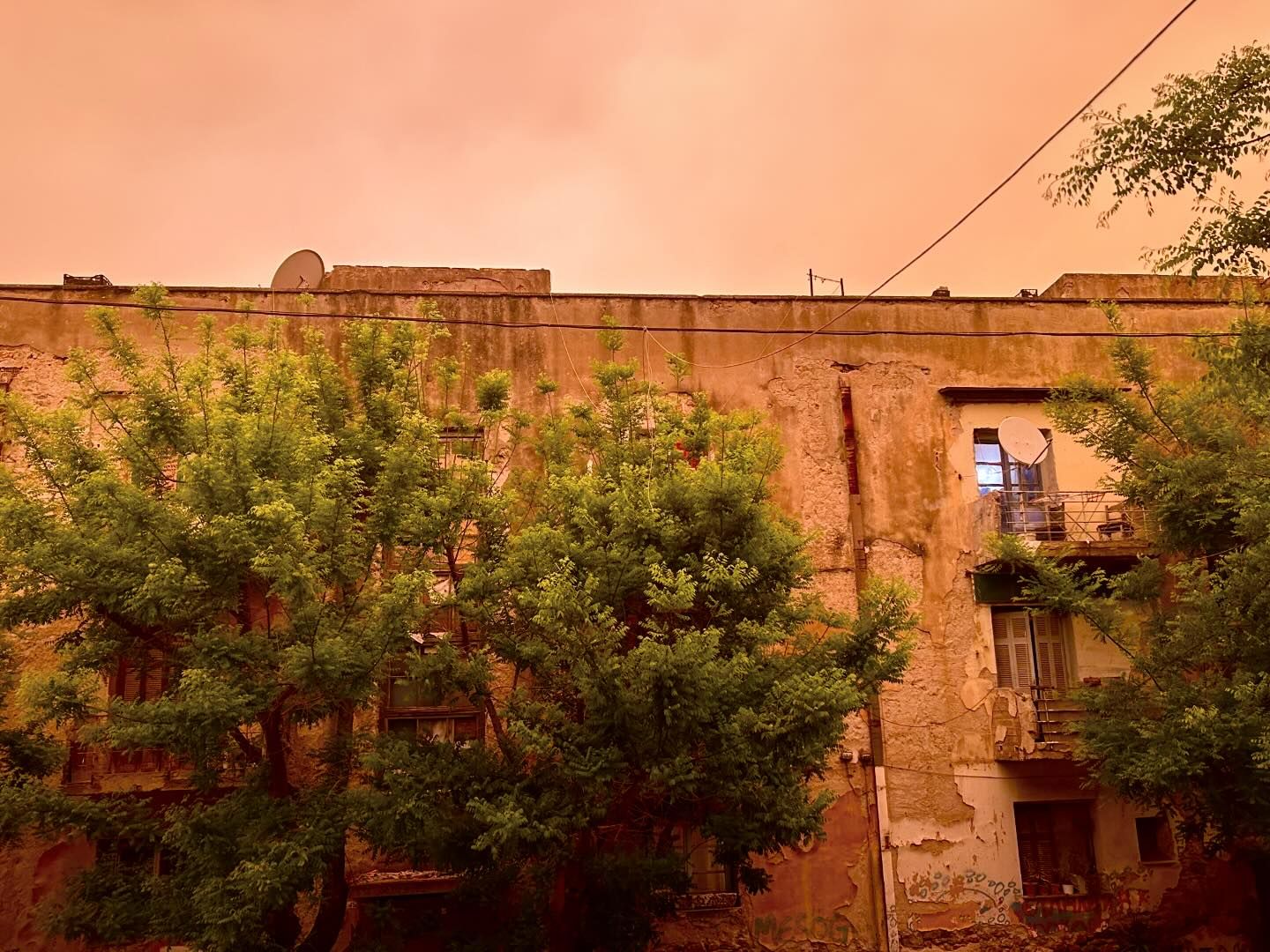
For 16 years, Prosfygika – the largest squat in Greece and most probably in Europe, spanning eight apartment blocks with more than 14 hectares – has brought together around 27 nationalities in a unique model of horizontal self-administration, self-sufficiency and communality. Through structures1 like a communal bakery, a children’s structure, a women’s structure, a health structure and open assemblies, the residents of Prosfygika have built a community based on solidarity, mutual aid and collective care.
Today the community stands in direkt opposition to the Greek state’s “redevelopment” plan, which seeks to displace its inhabitants and repurpose the prime urban space in central Athens as part of their broader gentrification effort in collaboration with the Region of Attica, DYPA (Public Employment Service).
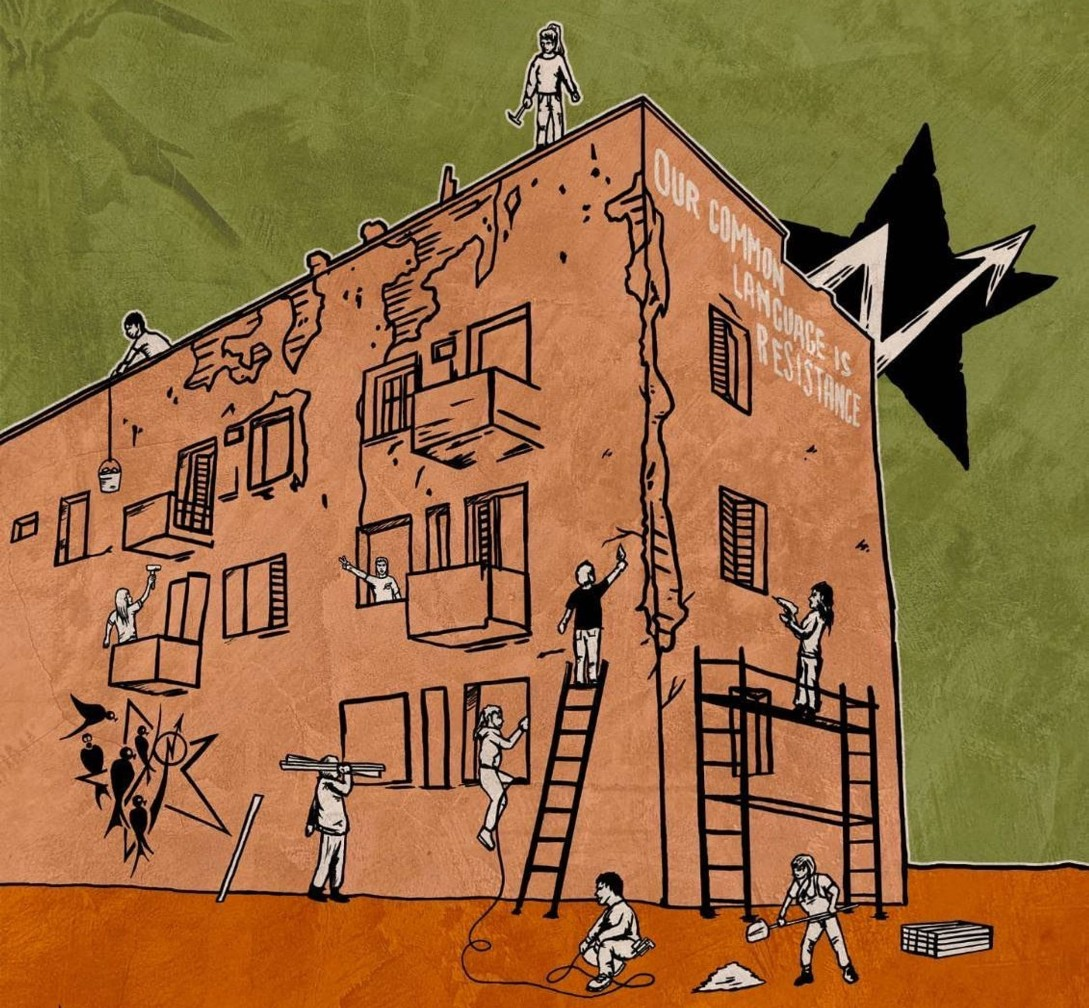
To protect their rights, their community and their living space, as well as the historical and collective memory of the buildings (which are listed as a monument of modern history), the community has proposed its own phased renovation plan. This would be carried out by the Community, its legal entity (Non-Profit Civil Law Company), the Committee for the promotion and defense of Prosfygika and its collective memory, and an already collaborating group of architects, civil engineers, archaeologists and researchers. This would allow all residents to remain on site and the historic building to be safely preserved and renovated.
This is the 5th, and major political offence against of the existence of the community in the last decades by the state. This time it is the most serious one due to the specific details of the plan and the confirmed funding. In the plans for the “redevelopment” of the area the people living there are mentioned solely as “mobile items”, and in state-media that supports the right-wing government of New Democracy, it becomes clear that they target the Community of Squatted Profygika as their Opposition.
To protect his community and the life oft its people, the inhabitant and member of the Community, Aristotelis Chantzis, decided on February 5 to start a hungerstrike until death for the defense of life. Today he is on hungerstrike for over 90 days. Since May 1, Suzon Doppagne stands alongside with him in the hunger strike until death. We now need the urgent support of large parts of the international society, to help us protecting the Community of Squatted Prosfygika, the life of the people living there and the vision of a united and self-determined society that Prosfygika is standing for.
Why Prosfygika Matters
Prosfygika is more than a local struggle: It embodies the power of marginalized communities to create resilient, self-sufficient spaces against all kinds of discrimination and oppression – even in face of the forces of gentrification and state repression. We believe that Prosfygika demonstrates the transformative potential of collective action and self-organisation, to find solutions to individual and societal problems in a moment of global polycrisis.
Through the building of permanent structures that respond to the existential needs of the people, proposals for all of society are being created. Communal life and collective ownership bring people across nationalities, religions, class and gender together, establishing ways to communicate, to support each other in challenging life and personal growth.
It’s exemplary of the necessity to protect self-determined ways of living against neoliberal urban policies – not just in Athens, but wherever people face displacement.
How You Can Support
As academics, your voice and resources can amplify Prosfygika’s fight for survival. We invite you to:
- Incorporate Prosfygika into your teaching—discuss its model of self-organization and resistance in lectures, seminars, or workshops.
- Consider research or fieldwork in Prosfygika, documenting its history, structures, or the broader context of urban resistance in Athens. You are warmly invited to visit Prosfygika in person to experience the community and its challenges firsthand.
- Express solidarity by mentioning Prosfygika in newsletters, mailing lists, or public statements, and by raising the issue in university committees and with colleagues, helping to build broader awareness and support for the community’s perspective. As a first step, you can sign the signatures list to support the demands of the hungerstrike.
- Please sign also the additional petition for academics
- Participate in the circular hungerstrike with your own statements, write letters to the EU-Commission or Greek embassies, or come to the Community of Squatted Prosfygika!
With respect to the specific fields of academia, we have some examples in mind, listed on the next page, that may be of interest to you.
The time to act is now – before another world is erased by profit and repression.
In solidarity,
Internationalist Committee for the Defense of the Community of Squatted Prosfygika
Resources & Contact
Learn more at www.saveprosfygika.gr or contact us at saveprosfygika@protonmail.com. Follow the campaign at #saveprosfygika.
Architecture / urban planning: The buildings of the neighbourhood were build in the Bauhaus style in 1923, as a fast solution for the 3 million refugees from minor asia beeing displaced after the Greco-Ottoman war. At the time, these buildings were designed to facilitate a communal way of living, which is preserved 100 years on by the contemporary community. For the real rescue of Prosfygika both as buildings and as a community, a self-managed plan to restore the neighbourhood is beeing implemented which will, along with preserving the historical memory that the authorities have so blatantly distorted and distortively vilified over the years, open more communal spaces for the Athenian society as a whole such as an interactive museum about the Greek civil war, an art-, and culture space and guest houses for the nearby Cancer Hospital.
Social work / psychology: The Community aims to give a holistic answer to the issues of each individual. Personal problems and problematic behaviours will be addressed collectively and solutions will be found. At the same time, the inhabitants are able to develop skills, practically and socially. The legal structure, health structure and children’s structure are actively involved in struggles for the acceptance of refugee children in schools and access to health insurance for refugees. As such, the community is an interesting and unique example of self-organised and community led initiatives for psychological and social support.
Geography: Geographic academics should engage with Prosfygika because it offers a rare empirical site where questions of urban commons, autonomous spatial production, migration, territoriality, and resistance to state-led redevelopment intersect. It allows researchers to study how alternative forms of governance, care, and political belonging are materially produced in everyday urban space. As a living archive of displacement, conflict, and self-organization, Prosfygika also provides a unique lens for examining the relationship between memory, infrastructure, and insurgent urban futures.
Political sciences: Prosfygika offers a rare site to study grassroots governance, autonomous political organization, and forms of citizenship enacted beyond or against the state. It provides insight into how power, sovereignty, and political legitimacy are negotiated, particularly in contexts of displacement, repression, and resistance. As such, Prosfygika challenges conventional understandings of governance and opens up alternative perspectives on democracy, autonomy, and political community.
Sociology: The Community provides a rich empirical setting to study collective life, solidarity, social reproduction, and community formation under conditions of precarity and conflict. It offers insight into how social relations, mutual aid, and collective identities are produced and maintained through everyday practices. As a space where marginalization and resistance intersect, Prosfygika also speaks to broader sociological debates on inequality, social movements, and alternative forms of living together.
Urban Studies / Urban planning: Urban scholars and planners should engage with Prosfygika because it offers a rare example of self-managed urbanism that challenges dominant models of state-led planning and market-driven redevelopment. It provides insight into housing struggles, informal governance, and alternative ways of organizing urban space. As a site of resistance to displacement and urban restructuring, Prosfygika opens critical perspectives on planning, justice, and the right to the city.
Socio-legal: Prosfygika provides a site for examining how legality, property, rights, and political authority are contested and negotiated in practice. It offers insight into the tensions between formal law and lived claims to space, shelter, and collective autonomy. As a space where law is both challenged and reworked from below, Prosfygika contributes to broader debates on informal rights, state power, and legal pluralism
Gender studies: The Community, especially the women’s structure, which emerged in response to the specific needs and interests of women in the community, offers important insight into how care, social reproduction, solidarity, and political struggle are shaped by gendered relations and practices. It provides a lens for examining how everyday forms of feminist resistance and community-making often rely on labor that is overlooked or unevenly distributed. As a site of collective life under precarity, Prosfygika also contributes to debates on feminist politics, intersectionality, and alternative forms of living together.
Communication studies: “Prosfygika brings struggles over meaning-making into sharp focus. State and media narratives frame “redevelopment” as progress while erasing residents as political subjects, foreclosing alternative ways of life rooted in collective care and self-organization, and manufacturing consent for gentrification and repression. At the same time, Prosfygika highlights an often overlooked dimension of discourse studies: resistance. Through societal outreach, digital communication, solidarity networks, prefiguration and embodied actions like hunger strikes, the community actively produces counter-discourses and challenges dominant representations. It shows how marginalized groups not only contest imposed meanings but also create and sustain alternative communicative worlds.
Economics: Economic scholars should engage with Prosfygika because it offers a valuable site for studying non-market exchange, collective provisioning, and alternative economic practices beyond capitalist logics. It provides insight into how solidarity economies, shared resources, and informal systems of support can sustain everyday life. As a space where economic survival is tied to collective organization, Prosfygika contributes to broader debates on alternative economies, precarity, and economic justice.
Communication studies: “Prosfygika brings struggles over meaning-making into sharp focus. State and media narratives frame “redevelopment” as progress while erasing residents as political subjects, foreclosing alternative ways of life rooted in collective care and self-organization, and manufacturing consent for gentrification and repression. At the same time, Prosfygika highlights an often overlooked dimension of discourse studies: resistance. Through societal outreach, digital communication, solidarity networks, prefiguration and embodied actions like hunger strikes, the community actively produces counter-discourses and challenges dominant representations. It shows how marginalized groups not only contest imposed meanings but also create and sustain alternative communicative worlds.
1 Structures are an attempt to find solutions for collectively identified needs, and are in this way proposals for societies how to organize themselves based on their needs.