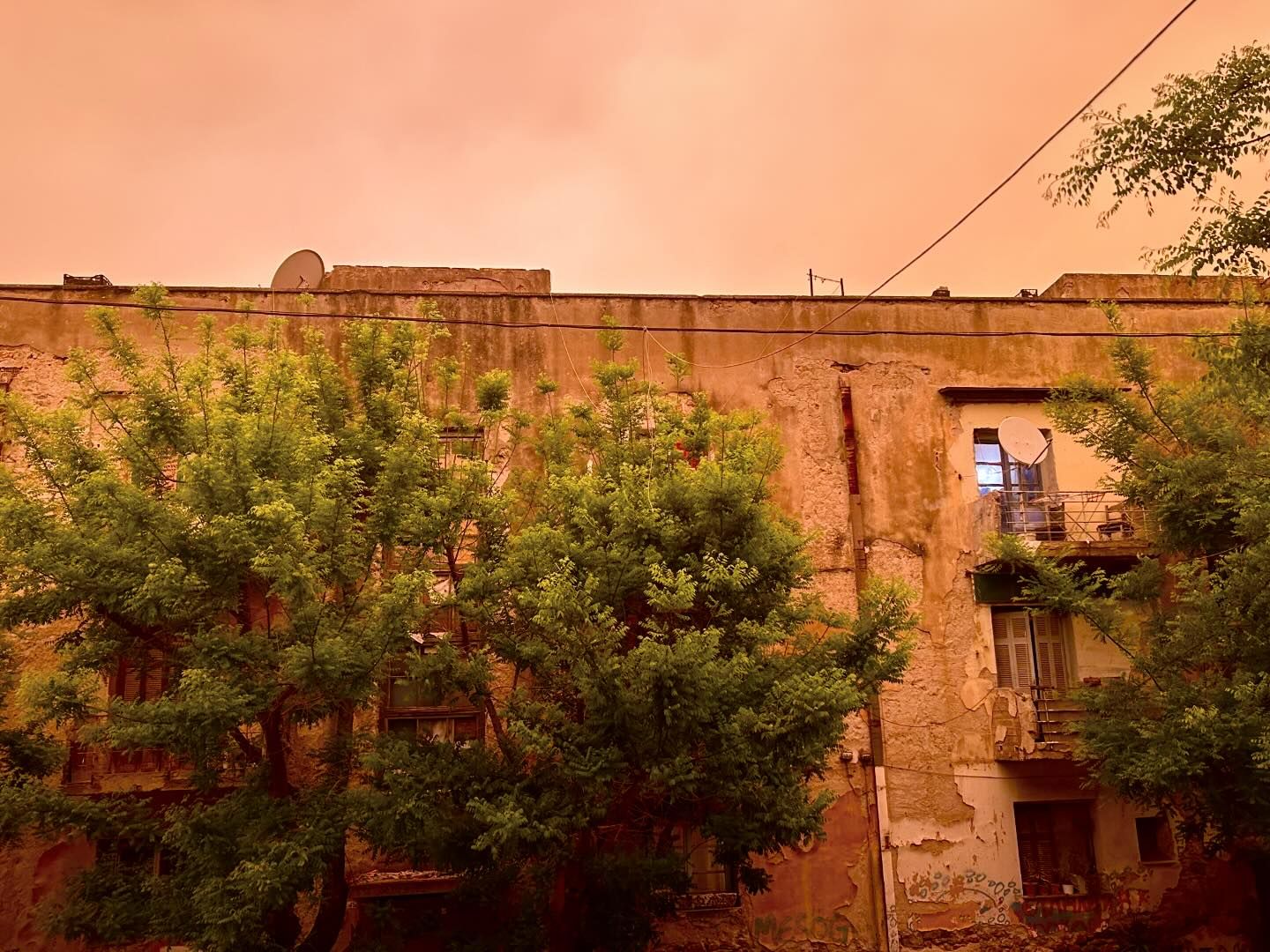
In the conditions of the social struggles that took place during the period 2008-2010, some of the squatters that lived in the neighborhood of “Prosfygika” realized that collectivization was the only solution for us. Firstly because of the architectural structure of the area which is designed for community life and secondly because we were suffering from micro-mafias that were looting the spaces. Since then, several solutions have been provided based on self-organization and also on problems that had to do sometimes with subletting, sometimes with drug trafficking and child sex trafficking. As an assembly that was oriented towards the ideals of communal ownership and perceived the value of use as the only value, until 2012 where the assembly of squatted prosfygika (SY.KA.PRO) was created.
Today, most of the neighborhood is occupied and inhabited. During these 10 years we have managed to fill the neighborhood with life, transforming it into the largest squatting community (spatially and numerically) in Greece, with 400/500 permanent residents and self-organized structures such as (children’s structure (house) and self- education, women’s structure, health structure, community coffee, adults and children’s cinema, collective kitchen, bakery structure, social center, 2 houses of internationalists, distribution of food from neighboring public markets, community internet, equipment for cleaning the sewerage, language lessons, youth structure, library structure etc.
We do not see our project as an “island of freedom”, nor do we have such illusions. We are a part of class, social and internationalist struggles and we see self-management and self-organization as the only way against the state and capitalism. The neighborhood of Prosfygika is a practical response to social and economic conditions imposed by sovereignty.
In Prosfygika people are living from all oppressed classes with different cultural, ethnic, religious and political backgrounds, political refugees mainly from Turkey and Kurdistan, people with and without papers, formerly homeless, displaced people from war fields by a system with its barbaric antagonism throws the ‘unclaimed’. This wide range of people forms a mosaic from below and constitutes the community which has self-consciousness and it progresses and evolves over the years.
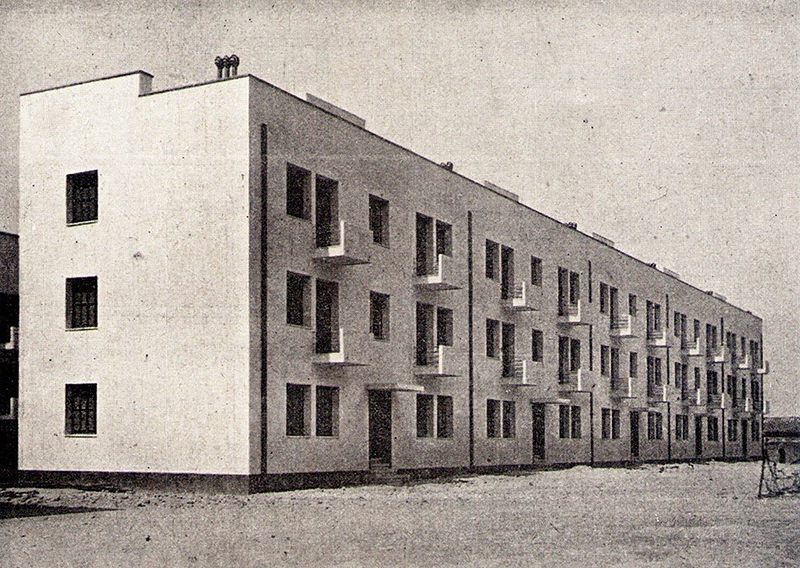
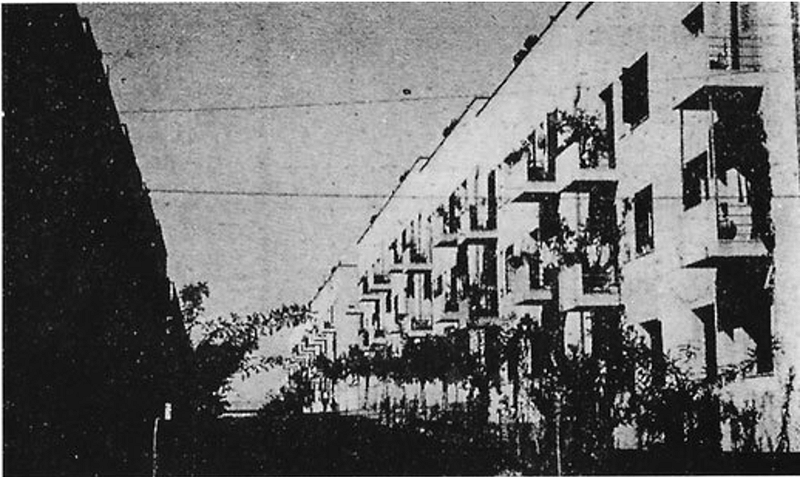
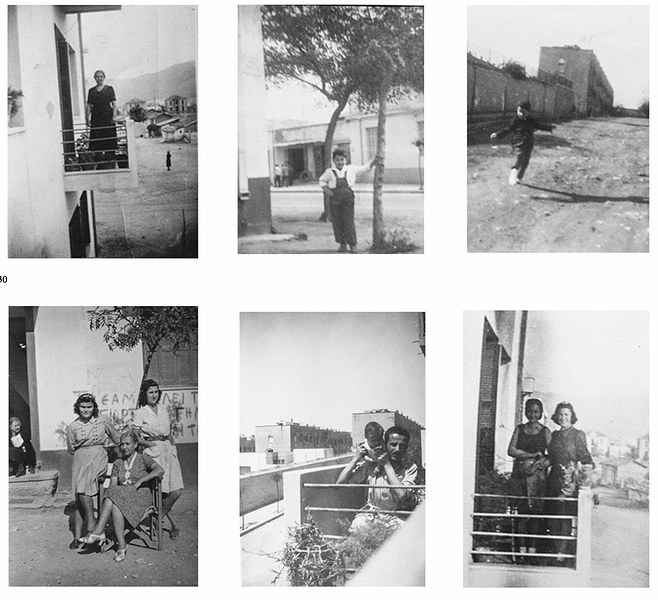
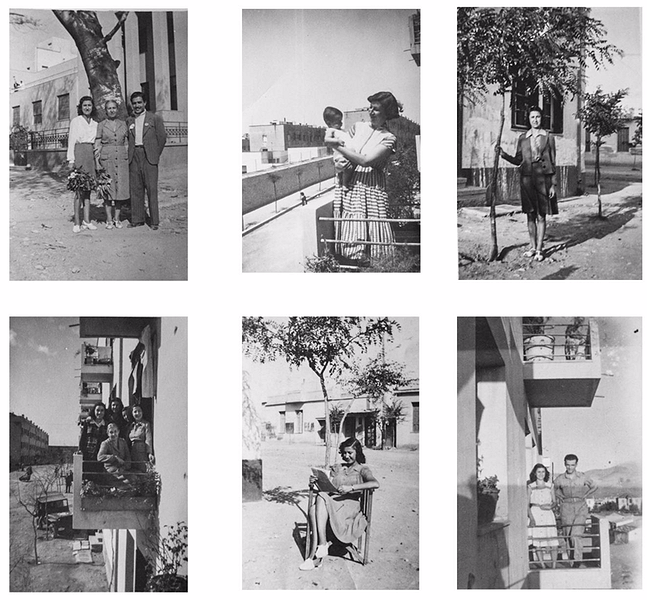
The land where Prosfygika was built (covering an area of 14,500 sq. m) was a subject of conflict since the 1920s after the Asia Minor catastrophe refugees settled building shacks. The fans of the newly formed Panathinaikos football team (the team was about 15 years old) were claiming the land for which they had already given money to the Greek state. Fights started between the refugees and the fans and finally the state intervened and gave the opposite land to build the stadium in 1933-1936. So the neighborhood was built as a complex of 228 apartments of 50 sq. m which were bought under favorable terms by the refugees, mainly from the camp Tourkovounia.
Over the years, the state has repeatedly threatened to “flatten” the historic neighborhood. The Junta was the first to issue a ministerial decision according to which the first 4 rows of houses would be demolished to build the Courthouse, a plan that finally did not move forward. Rumors of demolition and gentrification of the area continued for the following decades. In 1994 the (DEPOS) Public Company for Urban Planning and Housing proposed the renovation of 2 apartment buildings as a pilot project and then to continue with the rest, another plan that didn’t succeed. Finally, in the late 1990s, the decision was made to demolish the historic neighborhood in order to become a mall, an underground garage and to be integrated as a Panathinaikos stadium extension.
Thus, the (KED) State Real Estate Company presented and offered 25,000 euros in order for the residents to leave. If they refused they would lose their homes as the state would proceed with forced expropriation. The residents initially refused and the amount rose to 50,000 euros, while the objective value was estimated to be 75,000 euros. Until 2003, the state, under suffocating pressure, managed to evict most of the residents by practicing all the legal terrorism allowed since its establishment, and 177 apartments were transferred to the KED. 51 residents refused to give in terrorism and with the support of the School of Architecture appealed to the (STE) Council of State and after two court rulings, in 2003 the two front rows were declared as “newer historical monuments” as belonging to the Bauhaus movement and also carry up to today the signs from the fire received by the left forces during “Dekemvriana” events. (A worthy question of course is that an entire state ignored the historicity of the buildings and wanted to proceed with their demolition.)
In 2009, a year when the other 6 rows of houses were also characterized “preservable” and “newer historical monuments”, the (TEE) Technical Chamber of Greece requests the exchange of one of its own plot (the current Navarino Park in Exarchia) with 4 of Prosfygika apartment buildings in order to relocate headquarters of the Chamber and its library. The plan was not implemented. In 2014, 137 houses were transferred to the Public Private Property Utilization Fund (HRDH) and in 2016, the 177 apartments were transferred to the Attica Region. In 2018, the Council of State allowed the re-transfer of the 137 apartments to the HRDH and the Supreme Court of Cassation rejected the application of the Municipality of Athens, which claimed ownership of the property. In the same year, ANAPLASI SA was founded with Belavilas as president and the Syriza government announcing a European-style redevelopment of the refugees with a charity wrap and a museum exhibit. In 2019, the studies carried out with an individual donation (Hellenic Petroleum-ELPE) were granted to the Region and were put to public consultation. Today, while all the houses have been judged to be sustainable, the latest from the current government is the signing of a memorandum in December 2020 for the double renovation of the Botanical Garden and Avenue between Eleonas GDP (Alpha Bank & Piraeus Bank), the Municipality of Athens, Attica Region and ANAPLASI ATHENS SA, with Bakoyannis as Chairman of the Board, with unclear intentions for the “regeneration” as they stumble upon legislative road problems and unclear provisions on how to intervene on a monument. So they focus on the timeless project for the underground garage and the construction of a mall in place of the Panathinaikos stadium.
As it is obvious, from the constant transfers of property status and ambitious plans that are announced from time to time, Prosfygika has become an ‘opportunity’ in the various government services and everyone wants to “save” them from decadence as they claim, while the reality clearly shows us, that the state is the main corruptor of the collective memory of Prosfygika, as well as the mediator for all kinds of businessmen who see the space as a chance for profit. Putting forward, as a Trojan horse, the need to house the accompanying patients of St. Savvas, the need for a refugee museum or the need to house vulnerable groups, they shamelessly underestimate our intelligence. The “Christian Union”, which belongs to the Petraki Monastery, is the owner of the plot and the building facilities of Ag. Savva, and his invisible but general commander. It has entire buildings in the wider area that could be allocated for the needs of the hospitality of the accompanying patients of Ag. Savva, which of course he rents or leaves abandoned until he exploits them. As for the need for a refugee museum, not even the most conscientious can be convinced of their real intentions.
Prosfygika is a living organism and an integral part of the broader radical social movement. It is a shelter – home for refugees who survived the modern imperialist wars and fascist regimes. As a community consisting of refugees participating in modern social struggles, they can be described as a “living museum” without the approval of official bodies. The associations of “Asia Minor”, being descendants of refugees themselves, should ask themselves, how many refugees currently live in the apartments and whether the need for housing is superior to a museum. As for the vulnerable social groups for which the state is concerned, let us inform them that the majority of the inhabitants today belong to those groups. We are not convinced by the charitable policies of either the current or the previous government and certainly not any other. By deconstructing the social profile of gentrification, we should examine the cancelling of the “ESTIA” program, the general management of the migration issue, the abandonment and disuse of dormitories and the pre-planned full privatization of health and education. It is the state that creates the housing problems for vulnerable social groups and it won’t solve any problem with the “reuse’ of Prosfygika. Let’s not forget, Prosfygika gentrification plan is yet ‘another feast’ with public money ‘served,’ used by mayors, contractors, businessmen etc. At the same time, in the case of Prosfygika, the state shows that it seeks to become a regulator of collective memory and that the main purpose of mayors and government officials, in addition to profit, is to seize the political surplus value that the gentrification will produce in order to satisfy the mainstream and trendy reflexes of modern metropolitans.
It is known the “blur” caused by modernization and spectacle in the metropolitan centers such as futuristic works of art, Airbnb, expensive shops, restaurants and bars, offices of first-class companies, inhospitable parks, “smart” events in the streets of the center, which are meant for the rich and tourists, bypassing the systematic degradation that comes before the seizure of public space, the expulsion and repression of its natural residents and resistance movements. A city’s centre without inhabitants remains defenseless and at the mercy of businessmen, visitors – consumers and tourists. Without the natural relationship between people and places there is no chance of defending them. Some typical examples are the ones of Barcelona and Berlin where the inhabitants were pushed off in the suburbs and any life inside the centre is connected exclusively with entertainment and consumption.
Although in the advanced West as early as the 1980s the attack of the capitalism escalated with the privatization of natural resources, public spaces and social services, in Greece it was imposed in the at the time of the memoranda. A milestone and foundation for the development of modern society Capitalism in Greece was the 2004 Olympics, which forged the consciousness of the average Greek to unconditionally welcome the onslaught of capital, which served up as modernization.
By the means of repressing movements and the degradation of living standards, not only locally but also globally, extreme neo-liberalism is advancing and establishing itself. On the contrary, the battles of the local movements against privatization, for the preservation of natural heritage and public spaces as such, are generating new dynamics and perspectives for the overthrow of sovereignty.
The repression that squats are facing is the state’s attack on the most radical part of the antagonistic movement. It is an attack on the houses of struggle, the liberated spaces, the practice of self-organization, the incubators of young strugglers. It is a long-term war whose intensity increases in accordance depending on the dynamics and unity of the movement. On 23 July 2020, at dawn, a crew with drilling machines of the company “Redevelopment Athens SA” snuck into the neighborhood to carry out underground investigations and was thrown out as soon as it was noticed by the people of the community.
Without fetishizing specific practices, our guiding light is the fighting defense of the Community of squatted Prosfygika, whenever the state has attempted, either with its “legitimate” repressive powers, or with its “parastate” forces to invade the neighborhood and terrorize its people. The four major operations that took place in the years that the Community has been counting involve:
- 31 October 2016, where during the trial of Golden Dawn, fascists and police carried out a common operation of invasion.
- 9 November 2019, the prosecution of seven members of the Community and an invasion of the anti-terrorist police in a building.
- 22 November 2022, kidnapping and arrest of a comrade from the house he was staying and the following invasion of all kinds of repressive forces into the houses of an entire building complex and the arrest of 79 other members of the Community and solidarians.
- 20 June 2024, arrest of two members of the Community by a group of OPKE, inside a neighborhood street. This was prior to a detention on 18/6/2024 four more members within the neighbourhood and from an alleyway, followed on 19/6/2024 by the arrest of a 15-year-old from a nearby convenience store followed by torture outside and inside the GADA.
Facing the head-on attack of the state and capital we need to organize ourselves with central planning and not just follow the events in emergency procedures. It is imperative that we all come together and struggle, leaving behind the logic of selective solidarity. With the goal of political and physical continuity, the territorialization of the struggles, the liberation of spaces and mobilizing radical forces. It is necessary to build a common strategy with strong links, to strengthen local struggles with our physical presence and connect with the struggles being fought within and outside the borders.
We have made the decision to stay, fight and resist for our homes, for our community, for one more liberated land, and we will do it until the end.
Assembly of Squatted Prosfygika L. Alexandras – SY.KA.PRO
Email: sykapro.squat@riseup.net
Twitter: @Prosfygika
Blog: sykaprosquat.noblogs.org